BOOKS: |
| New Releases |
| Chicago Crime |
| Chicago History |
| Chicago Sports |
more... |
| Favorite Authors |
| Photographs |
Biography, A Chicago Writer
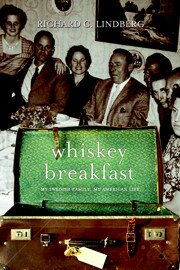
Rich has been researching and uncovering forgotten Chicago history for over 30 years. He has been featured on History's Mysteries, Cities of the Underworld, Justice Files, Mobsters, American Justice, Masterminds, and many television and radio programs of local and national origin including WBEZ, the local NPR affiliate in Chicago; In Search of History; plus Lost Worlds; two documentaries about Chicago gangland for the Travel Channel; a documentary about Chicago gambling boss Mike McDonald for Irish public television; two episodes of Evidence on Discovery plus numerous appearances on Milt Rosenberg's thought-provoking Extension 720 program, heard nightly on WGN Radio. Rich broke into print in 1977, beginning as a free-lance reporter for the Lerner Community Newspapers of Chicago, a talent incubator for many local journalists. He spent his nights covering sports, community events, fraternal associations, and political gatherings across the greater Northwest Side of Chicago. "WHISKEY BREAKFAST: MY SWEDISH FAMILY MY AMERICAN LIFE," Rich's cathartic memoir of growing up, The Whiskey Breakfast: My Swedish Family, My American Life, a book project he worked on for the better part of 22 years, was published in September 2011 by the University of Minnesota Press. It is a poignant, often heart rendering, multi-generational family tale inter-woven with the Sweden-to-America saga, the tragedy of divorce, financial hardship, abandonment, and the tormented boyhood world of bullies Rich was forced to endure at William J. Onahan School in Chicago during the 1960s. Media Praise for the Whiskey Breakfast "Lindberg serves up captivating historical tidbits and offers a window into the immigrant experience." “Whiskey Breakfast” won the 2012 Society of Midland Authors Finalist Award for Best biography of 2011.
Writing About Chicago – "The Gambler King of Clark Street" Wins the Society of Midland Authors 2009-2010 Biography Award and an Award of excellence from the Illinois state historical society
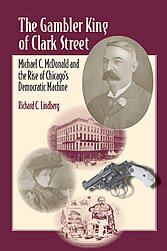
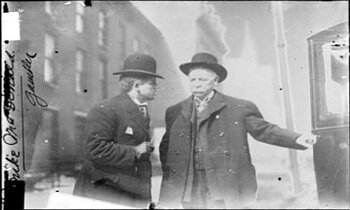
Rich's 2009 biography of Michael C. McDonald, Chicago's wily 19th Century political boss, roué, and roguish gambler, inspired The Gambler King of Clark Street: Michael C. McDonald and the Rise of the Chicago's Democratic Machine, was named the winner of the 2009-2010 Biography Prize from the Society of Midland Authors. Two weeks earlier, at a special luncheon held at the Governor’s Mansion in Springfield on April 24, 2010, Rich’s book - praised for its originality and scholarship - won a Certificate of Excellence from the Illinois State Historical Society. The McDonald story, a first-ever biography about this enigmatic but mostly forgotten gambler who built the foundation of the city's enduring, and eternally corrupt Democratic Machine still in power after 120 years today. With swagger and bravado, "King" Mike elected mayors, consulted with presidents, amassed a personal fortune and suffered mightily at the hands of two feckless wives who "done 'em wrong." With swagger and bravado, "King" Mike elected mayors, consulted with presidents, amassed a personal fortune and suffered mightily at the hands of two feckless wives who "done 'em wrong." His tragic personal life is interwoven with the intriguing story of the rise of organized crime in the Windy City; formulated by McDonald and his syndicate of gamblers, sharpers, bondsmen, sluggers and crooked politicians possessing colorful and oblique nicknames, a zest for the high life, and a gift for larceny on a grand scale.
PUBLISHED IN APRIL 2011
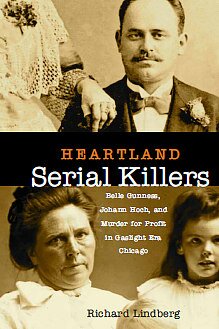
Heartland Serial Killers: Belle Gunness, Johann Hoch and Murder for Profit in Gaslight Era America, profiling Gunness and Hoch, two early 20th Century serial killers who placed advertisements in the lonely hearts columns of ethnic newspapers advertising for desperately lonely men and women to marry…swindle…and ultimately murder, was published by Northern Illinois University Press in DeKalb, IL, in April 2011. Belle Gunness carried out her bloody work in a rural farm house outside of LaPorte, Indiana from 1900-1908. Hoch, the lesser known fiend, was an apprentice to Dr. H.H. Holmes, the "master of murder castle" (more famously known as the "Devil in the White City") in the Englewood neighborhood of Chicago during the 1893 World's Fair. Hoch struck off on his own after his mentor, H.H. Holmes, was captured and hanged. Hoch, this squat, balding killer married 35 women in his time - about ten of them ended up in graves once their dowry and insurance policies were safely in his hand. Hoch and Gunness were contemporaries but they did not work together, nor did they know each, but if they had, one would have cancelled out the other. 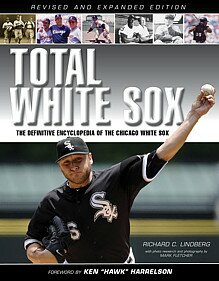
The third edition of Total White Sox – Rich's definitive 675-page history of the South Side team was also published in the spring of 2011 with complete updates through the 2010 season and many new photos and entries. Chicago-based Triumph Books is the publisher. The White Sox in Chapter and Verse…
Rich knows White Sox baseball. He grew up listening to the late-night broadcasts of Sox baseball by Bob Elson and Red Rush on WCFL and WMAQ Radio, and suffered the anguish of two blown pennants in 1964 and 1967. In the late 1970s Rich began filtering historical statistics and tidbits of information to Don Unferth, the team's director of media relations, based on his exhaustive exploration into Sox history. Gradually a role evolved for Rich as their "White Sox Team Historian" supplying historical data—lost for many decades—articles for team publications and various other projects. In 1988, Rich was on location in Indianapolis for the shooting of Eight Men Out. For months he had provided historical interpretation and tidbits of information to actors John Cusack, Gordon Clapp and D.B. Sweeney while assisting with the technical aspects to the cinematic re-telling of the "Black Sox Scandal." He even appeared as an on-camera extra in the movie—a Chicago police officer, appropriately.
In May 2008, the White Sox unveiled their "Legacy Plaza" - a historic commemoration of the first 109 years of team history outside of Gate 4 at the new U.S. Cellular Field. Rich provided the White Sox Marketing Department with a "timeline" of 200 of the most historic and significant events in team history that was to form the baseline of 200 bricks, each with a famous moment inscribed and laid out in the shape of a baseball diamond. In all, Rich has written five detailed White Sox histories including the 600-page Total White Sox, The 2011 update to Total Sox came out in April, 2011.


|